6.2 Cosmological parameters from 2dFGRS
6.2.1 The power spectrum of 2dF Galaxies on large scales
An initial estimate of the convolved, redshift-space power spectrum of the 2dFGRS was determined by
Percival et al. [72 ] for a sample of 160,000 redshifts. On scales
  , the data
are fairly robust and the shape of the power spectrum is not significantly affected by redshift-space
distortion or non-linear effects, while its overall amplitude is increased due to the linear redshift-space
distortion effect (see Section 5).
, the data
are fairly robust and the shape of the power spectrum is not significantly affected by redshift-space
distortion or non-linear effects, while its overall amplitude is increased due to the linear redshift-space
distortion effect (see Section 5).
If one fits the  -CDM model predictions to the 2dFGRS power spectrum (see Figure 24) over the
above range in
-CDM model predictions to the 2dFGRS power spectrum (see Figure 24) over the
above range in  , one can constrain the cosmological parameters. For instance, assuming a Gaussian prior
on the Hubble constant
, one can constrain the cosmological parameters. For instance, assuming a Gaussian prior
on the Hubble constant  (from [22]), Percival et al. [72] obtained the 68 percent confidence
limits on the shape parameter
(from [22]), Percival et al. [72] obtained the 68 percent confidence
limits on the shape parameter  , and a baryon fraction
  . For a
fixed set of cosmological parameters, i.e.,
. For a
fixed set of cosmological parameters, i.e.,  ,
,  ,
,  , and
, and  ,
the r.m.s. mass fluctuation amplitude of 2dFGRS galaxies smoothed over a top-hat radius of
,
the r.m.s. mass fluctuation amplitude of 2dFGRS galaxies smoothed over a top-hat radius of  in redshift space turned out to be
  .
.
6.2.2 An upper limit on neutrino masses
The recent results of atmospheric and solar neutrino oscillations [24, 1] imply non-zero mass-squared
differences of the three neutrino flavours. While these oscillation experiments do not directly determine the
absolute neutrino masses, a simple assumption of the neutrino mass hierarchy suggests a lower limit on the
neutrino mass density parameter,  . Large scale structure data can put an
upper limit on the ratio
. Large scale structure data can put an
upper limit on the ratio  due to the neutrino ’free streaming’ effect [33]. By comparing the 2dF
galaxy power-spectrum of fluctuations with a four-component model (baryons, cold dark matter, a
cosmological constant, and massive neutrinos) it was estimated that
due to the neutrino ’free streaming’ effect [33]. By comparing the 2dF
galaxy power-spectrum of fluctuations with a four-component model (baryons, cold dark matter, a
cosmological constant, and massive neutrinos) it was estimated that  (95% CL), or
with concordance prior of
(95% CL), or
with concordance prior of  ,
,  , or an upper limit of
  on the total
neutrino mass, assuming a prior of
on the total
neutrino mass, assuming a prior of  [20, 19] (see Figure 24). In order to minimize
systematic effects due to biasing and non-linear growth, the analysis was restricted to the range
[20, 19] (see Figure 24). In order to minimize
systematic effects due to biasing and non-linear growth, the analysis was restricted to the range
 . Additional cosmological data sets bring down this upper limit by a factor of
two [79].
. Additional cosmological data sets bring down this upper limit by a factor of
two [79].
6.2.3 Combining 2dFGRS and CMB
While the CMB probes the fluctuations in matter, the galaxy redshift surveys measure the perturbations in
the light distribution of particular tracer (e.g., galaxies of certain type). Therefore, for a fixed set of
cosmological parameters, a combination of the two can better constrain cosmological parameters, and it
can also provide important information on the way galaxies are ‘biased’ relative to the mass
fluctuations,
The CMB fluctuations are commonly represented by the spherical harmonics  . The connection
between the harmonic
. The connection
between the harmonic  and
and  is roughly
for a spatially-flat Universe. For  , the 2dFGRS range
  corresponds
approximately to
corresponds
approximately to  , which is well covered by the recent CMB experiments.
Recent CMB measurements have been used in combination with the 2dF power spectrum. Efstathiou et
al. [17] showed that 2dFGRS+CMB provide evidence for a positive cosmological constant  (assuming
  ), independently of the studies of supernovae Ia. As explained in [72], the
shapes of the CMB and the 2dFGRS power spectra are insensitive to Dark Energy. The main
important effect of the dark energy is to alter the angular diameter distance to the last scattering,
and thus the position of the first acoustic peak. Indeed, the latest result from a combination
of WMAP with 2dFGRS and other probes gives
), independently of the studies of supernovae Ia. As explained in [72], the
shapes of the CMB and the 2dFGRS power spectra are insensitive to Dark Energy. The main
important effect of the dark energy is to alter the angular diameter distance to the last scattering,
and thus the position of the first acoustic peak. Indeed, the latest result from a combination
of WMAP with 2dFGRS and other probes gives  ,
,  ,
,
 ,
,  ,
,  , and
, and  (95% CL, assuming
 ) [79].
6.2.4 Redshift-space distortion
An independent measurement of cosmological parameters on the basis of 2dFGRS comes from
redshift-space distortions on scales 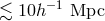 : a correlation function
  in parallel and
transverse pair separations
in parallel and
transverse pair separations  and
and  . As described in Section 5, the distortion pattern is a combination
of the coherent infall, parameterized by
. As described in Section 5, the distortion pattern is a combination
of the coherent infall, parameterized by  and random motions modelled by an exponential
velocity distribution function (see Equation (133)). This methodology has been applied by many
authors. For instance, Peacock et al. [66] derived
and random motions modelled by an exponential
velocity distribution function (see Equation (133)). This methodology has been applied by many
authors. For instance, Peacock et al. [66] derived  , and
Hawkins et al. [30] obtained
, and
Hawkins et al. [30] obtained  and a velocity dispersion
 . Using the full 2dF+CMB likelihood function on the
  ) plane,
Lahav et al. [42] derived a slightly larger (but consistent within the quoted error-bars) value,
) plane,
Lahav et al. [42] derived a slightly larger (but consistent within the quoted error-bars) value,
 .
.
6.2.5 The bi-spectrum and higher moments
It is well established that important information on the non-linear growth of structure is encoded at the
high order moments, e.g., the skewness or its Fourier version, the bi-spectrum. Verde et al. [95] computed
the bi-spectrum of 2dFGRS and used it to measure the bias parameter of the galaxies. They assumed a
specific quadratic biasing model:
By analysing 80 million triangle configurations in the wavenumber range  they
found
they
found  and
and  , in support of no biasing on large scale. This is a
non-trivial result, as the analysis covers non-linear scales. Baugh et al. [5] and Croton et al. [14] measured
the moments of the galaxy count probability distribution function in 2dFGRG up to order
, in support of no biasing on large scale. This is a
non-trivial result, as the analysis covers non-linear scales. Baugh et al. [5] and Croton et al. [14] measured
the moments of the galaxy count probability distribution function in 2dFGRG up to order
 (order
  is the variance,
  is the skewness, etc.). They demonstrated the
hierarchical scaling of the averaged
is the skewness, etc.). They demonstrated the
hierarchical scaling of the averaged  -point galaxy correlation functions. However, they found that
the higher moments are strongly affected by the presence of two massive superclusters in the
2dFGRS volume. This poses the question of whether 2dFGRS is a ’fair sample’ for high order
moments.
-point galaxy correlation functions. However, they found that
the higher moments are strongly affected by the presence of two massive superclusters in the
2dFGRS volume. This poses the question of whether 2dFGRS is a ’fair sample’ for high order
moments.

 ,
,  , and
, and  (bottom to top lines). The other parameters are fixed to the concordance model. The good fit of the
linear theory power spectrum at
(bottom to top lines). The other parameters are fixed to the concordance model. The good fit of the
linear theory power spectrum at  is due to a conspiracy between the non-linear
gravitational growth and the finger-of-God smearing
is due to a conspiracy between the non-linear
gravitational growth and the finger-of-God smearing 





