6.1 The latest galaxy redshift surveys
Redshifts surveys in the 1980s and the 1990s (e.g., the CfA, IRAS, and Las campanas surveys) measured
thousands to tens of thousands galaxy redshifts. Multifibre technology now allows us to measure redshifts of
millions of galaxies. Below we summarize briefly the properties of the main new surveys 2dFGRS, SDSS,
6dF, VIRMOS, DEEP2, and we discuss key results from 2dFGRS and SDSS. Further analysis of these
surveys is currently underway.
6.1.1 The 2dF galaxy redshift survey
The Anglo-Australian 2-degree Field Galaxy Redshift (2dFGRS) [89] has recently been completed with
redshifts for 230,000 galaxies selected from the APM catalogue December 2002) down to an extinction
corrected magnitude limit of  . The main survey regions are two declination strips, in the
northern and southern Galactic hemispheres, and also 100 random fields, covering in total about
. The main survey regions are two declination strips, in the
northern and southern Galactic hemispheres, and also 100 random fields, covering in total about
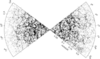
 (see Figures 20 and 21). The median redshift of the 2dFGRS is
  (see [11, 65] for
reviews).
(see [11, 65] for
reviews).
6.1.2 The SDSS galaxy redshift survey
The SDSS (Sloan Digital Sky Survey) is a U.S.–Japan–Germany joint project to image a quarter of the
Celestial Sphere at high Galactic latitude as well as to obtain spectra of galaxies and quasars from the
imaging data[93]. The dedicated 2.5 meter telescope at Apache Point Observatory is equipped with a
multi-CCD camera with five broad bands centered at 3561, 4676, 6176, 7494, and 8873 Å. For further
details of SDSS, see [102, 80]
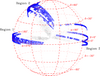
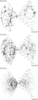
The latest map of the SDSS galaxy distribution, together with a typical slice, are shown in Figures 22
and 23 (see also [32 ]). The three-dimensional map centered on us in the equatorial coordinate system is
shown Figure 22. Redshift slices of galaxies centered around the equatorial plane with various redshift
limits and thicknesses of planes are shown in Figure 23:
]). The three-dimensional map centered on us in the equatorial coordinate system is
shown Figure 22. Redshift slices of galaxies centered around the equatorial plane with various redshift
limits and thicknesses of planes are shown in Figure 23:  with thickness of
  centered around the equatorial plane in the upper-left panel;
  with a thickness of
 in the upper-right panel;
  with a thickness of
  in the lower
panel.
in the lower
panel.
6.1.3 The 6dF galaxy redshift survey
The 6dF (6-degree Field) [90] is a survey of redshifts and peculiar velocities of galaxies selected primarily in
the Near Infrared from the new 2MASS (Two Micron All Sky Survey) catalogue[94]. One goal is to measure
redshifts of more than 170,000 galaxies over nearly the entire Southern sky. Another exciting aim
of the survey is to measure peculiar velocities (using 2MASS photometry and 6dF velocity
dispersions) of about 15,000 galaxies out to  . The high quality data of this survey could
revive peculiar velocities as a cosmological probe (which was very popular about 10 – 15 years
ago). Observations have so far obtained nearly 40,000 redshifts and completion is expected in
2005.
. The high quality data of this survey could
revive peculiar velocities as a cosmological probe (which was very popular about 10 – 15 years
ago). Observations have so far obtained nearly 40,000 redshifts and completion is expected in
2005.
6.1.4 The DEEP galaxy redshift survey
The DEEP survey is a two-phased project using the Keck telescopes to study the properties and
distribution of high redshift galaxies [91]. Phase 1 used the LRIS spectrograph to study a sample
of  1000 galaxies to a limit of I = 24.5. Phase 2 of the DEEP project will use the new
DEIMOS spectrograph to obtain spectra of
1000 galaxies to a limit of I = 24.5. Phase 2 of the DEEP project will use the new
DEIMOS spectrograph to obtain spectra of  65,000 faint galaxies with redshifts
  . The
scientific goals are to study the evolution of properties of galaxies and the evolution of the
clustering of galaxies compared to samples at low redshift. The survey is designed to have the
fidelity of local redshift surveys such as the LCRS survey, and to be complementary to ongoing
large redshift surveys such as the SDSS project and the 2dF survey. The DEIMOS/DEEP or
DEEP2 survey will be executed with resolution R 4000, and we therefore expect to measure
linewidths and rotation curves for a substantial fraction of the target galaxies. DEEP2 will thus
also be complementary to the VLT/VIRMOS project, which will survey more galaxies in a
larger region of the sky, but with much lower spectral resolution and with fewer objects at high
redshift.
. The
scientific goals are to study the evolution of properties of galaxies and the evolution of the
clustering of galaxies compared to samples at low redshift. The survey is designed to have the
fidelity of local redshift surveys such as the LCRS survey, and to be complementary to ongoing
large redshift surveys such as the SDSS project and the 2dF survey. The DEIMOS/DEEP or
DEEP2 survey will be executed with resolution R 4000, and we therefore expect to measure
linewidths and rotation curves for a substantial fraction of the target galaxies. DEEP2 will thus
also be complementary to the VLT/VIRMOS project, which will survey more galaxies in a
larger region of the sky, but with much lower spectral resolution and with fewer objects at high
redshift.
6.1.5 The VIRMOS galaxy redshift survey
The on-going Franco-Italian VIRMOS project[92] has delivered the VIMOS spectrograph for the European
Southern Observatory Very Large Telescope (ESO-VLT). VIMOS is a VIsible imaging Multi-Object
Spectrograph with outstanding multiplex capabilities: With 10 arcsec slits, spectra can be taken of 600
objects simultaneously. In integral field mode, a 6400-fibre Integral Field Unit (IFU) provides spectroscopy
for all objects covering a  area. VIMOS therefore provides unsurpassed efficiency for large
surveys. The VIRMOS project consists of: construction of VIMOS, and a Mask Manufacturing Unit
for the ESO-VLT. The VIRMOS-VLT Deep Survey (VVDS), a comprehensive imaging and
redshift survey of the deep Universe based on more than 150,000 redshifts in four 4 square-degree
fields.
area. VIMOS therefore provides unsurpassed efficiency for large
surveys. The VIRMOS project consists of: construction of VIMOS, and a Mask Manufacturing Unit
for the ESO-VLT. The VIRMOS-VLT Deep Survey (VVDS), a comprehensive imaging and
redshift survey of the deep Universe based on more than 150,000 redshifts in four 4 square-degree
fields.
 and 21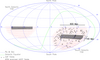
 and
and  (upper panel),
  and
and
 (middle panel), and
  and
and  (lower panel). The size of points has
been adjusted. Note that the data for the Southern part are sparser than those for the Northern
part, especially for thick slices. (Figure taken from
(lower panel). The size of points has
been adjusted. Note that the data for the Southern part are sparser than those for the Northern
part, especially for thick slices. (Figure taken from 

