 ).
).
Using Equation (157), the two-point correlation function in the cosmological redshift space,
 , is computed as
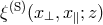 is the redshift-space correlation function defined through Equation (131).
Since  and
and  are defined in redshift space, the proper weight should be
 and
and  denote the number densities of the objects in cosmological redshift space
and comoving space, respectively, and
denote the number densities of the objects in cosmological redshift space
and comoving space, respectively, and  is the selection function determined by the observational
target selection and the luminosity function of the objects. Then, the final expressions [84
is the selection function determined by the observational
target selection and the luminosity function of the objects. Then, the final expressions [84 ] reduce to
where
] reduce to
where  and
and  denote the redshift range of the survey,
  is the comoving
volume element per unit solid angle.
is the comoving
volume element per unit solid angle.
Note that  and
and  , defined in
  and
and  , are related to their comoving
counterparts at
, are related to their comoving
counterparts at  through Equations (158) and (154), while those in
 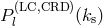 and
and  are not specifically related to any comoving wavenumber and separation. Rather, they correspond to the
quantities averaged over the range of
are not specifically related to any comoving wavenumber and separation. Rather, they correspond to the
quantities averaged over the range of  satisfying the observable conditions
  and
and  .
.
Let us show specific examples of the two-point clustering statistics on a light-cone in cosmological redshift space. We consider SCDM and LCDM models, and take into account the selection functions relevant to the upcoming SDSS spectroscopic samples of galaxies and quasars by adopting the B-band limiting magnitudes of 19 and 20, respectively.
Figure 18 compares the predictions for the angle-averaged (monopole) power spectra under various
approximations. The upper and lower panels adopt the selection functions appropriate for galaxies in
compares the predictions for the angle-averaged (monopole) power spectra under various
approximations. The upper and lower panels adopt the selection functions appropriate for galaxies in
 and QSOs in
  , respectively. The left and right panels present the
results in SCDM and LCDM models. For simplicity we adopt a scale-independent linear bias model [23]:
, respectively. The left and right panels present the
results in SCDM and LCDM models. For simplicity we adopt a scale-independent linear bias model [23]:
 and
and  for galaxies and quasars, respectively.
 ].)
].) The upper and lower panels correspond to magnitude-limited samples of galaxies ( in
in
 ; no bias model) and QSOs (
 in
in  ; Fry’s linear bias model),
respectively. We present the results normalized by the real-space power spectrum in linear theory
; Fry’s linear bias model),
respectively. We present the results normalized by the real-space power spectrum in linear theory
 [4], and
 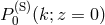 ,
,  ,
,  , and
, and 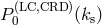 are computed using the nonlinear power spectrum [67].
Consider first the results for the galaxy sample (upper panels). On linear scales ( ),
),
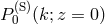 plotted in dashed lines is enhanced relative to that in real space, mainly due to a
linear redshift-space distortion (the Kaiser factor in Equation (131)). For nonlinear scales,
the nonlinear gravitational evolution increases the power spectrum in real space, while the
finger-of-God effect suppresses that in redshift space. Thus, the net result is sensitive to the shape
and the amplitude of the fluctuation spectrum, itself; in the LCDM model that we adopted,
the nonlinear gravitational growth in real space is stronger than the suppression due to the
finger-of-God effect. Thus,
plotted in dashed lines is enhanced relative to that in real space, mainly due to a
linear redshift-space distortion (the Kaiser factor in Equation (131)). For nonlinear scales,
the nonlinear gravitational evolution increases the power spectrum in real space, while the
finger-of-God effect suppresses that in redshift space. Thus, the net result is sensitive to the shape
and the amplitude of the fluctuation spectrum, itself; in the LCDM model that we adopted,
the nonlinear gravitational growth in real space is stronger than the suppression due to the
finger-of-God effect. Thus, 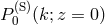 becomes larger than its real-space counterpart in
linear theory. In the SCDM model, however, this is opposite and
becomes larger than its real-space counterpart in
linear theory. In the SCDM model, however, this is opposite and 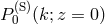 becomes
smaller.
becomes
smaller.
The power spectra at  (dash-dotted lines) are smaller than those at
  by the
corresponding growth factor of the fluctuations, and one might expect that the amplitude of the power
spectra on the light-cone (solid lines) would be in-between the two. While this is correct, if we use the
comoving wavenumber, the actual observation on the light-cone in the cosmological redshift space
should be expressed in terms of
by the
corresponding growth factor of the fluctuations, and one might expect that the amplitude of the power
spectra on the light-cone (solid lines) would be in-between the two. While this is correct, if we use the
comoving wavenumber, the actual observation on the light-cone in the cosmological redshift space
should be expressed in terms of  (see Equation (158)). If we plot the power spectra at
 taking into account the geometrical distortion,
  in the dotted lines
becomes significantly larger than
in the dotted lines
becomes significantly larger than 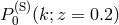 . Therefore,
 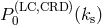 should take a
value between those of
should take a
value between those of  and
and  . This
explains the qualitative features shown in the upper panels of Figure 18. As a result, both
the cosmological redshift-space distortion and the light-cone effect substantially change the
predicted shape and amplitude of the power spectra, even for the galaxy sample [60]. The
results for the QSO sample can be basically understood in a similar manner, except that the
evolution of the bias makes a significant difference, since the sample extends to much higher
redshifts.
. This
explains the qualitative features shown in the upper panels of Figure 18. As a result, both
the cosmological redshift-space distortion and the light-cone effect substantially change the
predicted shape and amplitude of the power spectra, even for the galaxy sample [60]. The
results for the QSO sample can be basically understood in a similar manner, except that the
evolution of the bias makes a significant difference, since the sample extends to much higher
redshifts.
Figure 19 shows the results for the angle-averaged (monopole) two-point correlation functions, exactly
corresponding to those in Figure 18. The results in this figure can also be understood by an analogy of
those presented in Figure 18 at  . Unlike the power spectra, however, two-point correlation
functions are not positive definite. The funny features in Figure 19 on scales larger than
. Unlike the power spectra, however, two-point correlation
functions are not positive definite. The funny features in Figure 19 on scales larger than  (
( ) in SCDM (LCDM) originate from the fact that
  becomes negative
there.
becomes negative
there.
In fact, since the resulting predictions are sensitive to the bias, which is unlikely to quantitatively be
specified by theory, the present methodology will find two completely different applications. For relatively
shallower catalogues, like galaxy samples, the evolution of bias is not supposed to be so strong. Thus, one
may estimate the cosmological parameters from the observed degree of the redshift distortion, as has been
conducted conventionally. Most importantly, we can correct for the systematics due to the
light-cone and geometrical distortion effects, which affect the estimate of the parameters by
 10%. Alternatively, for deeper catalogues like high-redshift quasar samples, one can extract
information on the object-dependent bias only by correcting the observed data on the basis of our
formulae.
10%. Alternatively, for deeper catalogues like high-redshift quasar samples, one can extract
information on the object-dependent bias only by correcting the observed data on the basis of our
formulae.
In a sense, the former approach uses the light-cone and geometrical distortion effects as real cosmological signals, while the latter regards them as inevitable, but physically removable, noise. In both cases, the present methodology is important in properly interpreting the observations of the Universe at high redshifts.
 |
 |
 |
| http://www.livingreviews.org/lrr-2004-8 |
© Max Planck Society and the author(s)
Problems/comments to |


![3 (CRD) CRD 2 3 com 2 2 d s [ϕ(z)n0 (z)] = d x [ϕ (z )n 0 (z)]c⊥ (z )c∥(z), (167 )](article722x.gif)
![∫ zmax dVc- com 2 2 (CRD) dz dz [ϕ (z)n0 (z)]c⊥ (z)c∥(z)P l (ks;z) P (lLC,CRD )(ks) = -zmin--∫-zmax-------------------------------------, (168 ) dz dVc[ϕ(z)ncom(z)]2c⊥(z)2c∥(z ) zmin dz 0 ∫ z max dVc- com 2 2 CRD (LC,CRD ) z dz dz [ϕ (z)n0 (z)]c⊥ (z)c∥(z)ξl (xs;z) ξl (xs) = --min-∫-zmax------------------------------------, (169 ) dz dVc[ϕ(z)nc0om(z)]2c⊥(z)2c∥(z) zmin dz](article726x.gif)
![--1-- b(z) = 1 + D (z)[b(k, z = 0) − 1 ], (170 )](article742x.gif)
