 shows
shows
 .) Before embarking on this exercise, some
proper cautions ought to be given. First, the current CMB data is not only noisy, with in some cases
uncertain calibration, but will still have present within it residual contamination, either from the
Galaxy, or from discrete radio sources, or both. Experimenters make their best efforts to remove
these effects, or to choose observing strategies that minimise them, but the process of getting
really ‘clean’ CMB results, free of these effects to some guaranteed level of accuracy, is still
only in its infancy. Secondly, in any comparison of theory and data where parameters are to
be estimated, the results for the parameters are only as good as the underlying theoretical
models and assumptions that went into them. If CDM turns out not to be a viable theory for
example, then the bounds on
.) Before embarking on this exercise, some
proper cautions ought to be given. First, the current CMB data is not only noisy, with in some cases
uncertain calibration, but will still have present within it residual contamination, either from the
Galaxy, or from discrete radio sources, or both. Experimenters make their best efforts to remove
these effects, or to choose observing strategies that minimise them, but the process of getting
really ‘clean’ CMB results, free of these effects to some guaranteed level of accuracy, is still
only in its infancy. Secondly, in any comparison of theory and data where parameters are to
be estimated, the results for the parameters are only as good as the underlying theoretical
models and assumptions that went into them. If CDM turns out not to be a viable theory for
example, then the bounds on  derived below will have to be recomputed for whatever theory
replaces it. Many of the ingredients which go into the form of the power spectrum are not totally
theory-specific (this includes the physics of recombination, which involves only well-understood
atomic physics), so that one can hope that at least some of the results found will not change too
radically.
derived below will have to be recomputed for whatever theory
replaces it. Many of the ingredients which go into the form of the power spectrum are not totally
theory-specific (this includes the physics of recombination, which involves only well-understood
atomic physics), so that one can hope that at least some of the results found will not change too
radically.
Bearing these caveats in mind, it is certainly of interest to begin this process of quantitative comparison
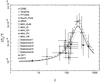
of CMB data with theoretical curves. Figure 21 shows
 ],
1997.)
],
1997.) a set of recent data points, many of them discussed above, put on a common scale (which may effectively
be treated as  ), and compared with an analytical representation of the first Doppler peak in a
CDM model. The work required to convert the data to this common framework is substantial, and is
discussed in Hancock et al. (1997) [35], from where this figure was taken. The analytical version of the
power spectrum is parameterised by its location in height and left/right position, and enables one
to construct a likelihood surface for the parameters
), and compared with an analytical representation of the first Doppler peak in a
CDM model. The work required to convert the data to this common framework is substantial, and is
discussed in Hancock et al. (1997) [35], from where this figure was taken. The analytical version of the
power spectrum is parameterised by its location in height and left/right position, and enables one
to construct a likelihood surface for the parameters  and
and  , where
  is the
height of the peak, and is related to a combination of
is the
height of the peak, and is related to a combination of  and
and  , as discussed above. The
dotted and dashed extreme curves in Figure 21 indicate the best fit curves corresponding to
varying the Saskatoon calibration by ±14%. The central fit yields a 68% confidence interval of
, as discussed above. The
dotted and dashed extreme curves in Figure 21 indicate the best fit curves corresponding to
varying the Saskatoon calibration by ±14%. The central fit yields a 68% confidence interval of
 after marginalisation over the value of
  .
Incorporating nucleosynthesis information as well, as sketched above (specifically the Copi et al. [22]
bounds of
.
Incorporating nucleosynthesis information as well, as sketched above (specifically the Copi et al. [22]
bounds of  are assumed), a 68% confidence interval for
  of
is obtained. This range ignores the Saskatoon calibration uncertainty. Generally, in the range of parameters
of current interest, increasing
of
is obtained. This range ignores the Saskatoon calibration uncertainty. Generally, in the range of parameters
of current interest, increasing  lowers the height of the peak. Thus taking the Saskatoon calibration to
be lower than nominal, for example by the 14% figure quoted as the one-sigma error, enables us to
raise the allowed range for
lowers the height of the peak. Thus taking the Saskatoon calibration to
be lower than nominal, for example by the 14% figure quoted as the one-sigma error, enables us to
raise the allowed range for  . By this means, an upper limit closer to 70 km s–1 Mpc–1 is
obtained.
. By this means, an upper limit closer to 70 km s–1 Mpc–1 is
obtained.
The best angular resolution offered by MAP is 12 arcmin, in its highest frequency channel at 90 GHz,
and the median resolution of its channels is more like 30 arcmin. This means that it may have
difficulty in pining down the full shape of the first and certainly secondary Doppler peaks in the
power spectrum. On the other hand, the angular resolution of the Planck Surveyor extends
down to 5 arcmin, with a median (across the six channels most useful for CMB work) of about
10 arcmin. This means that it will be able to determine the power spectrum to good accuracy, all
the way into the secondary peaks, and that consequently very good accuracy in determining
cosmological parameters will be possible. Figure 19, taken from the Planck Surveyor Phase A study
document, shows the accuracy to which  ,
,  and
and  can be recovered, given coverage of 1/3
of the sky with sensitivity 2 × 10⁻⁶ in
can be recovered, given coverage of 1/3
of the sky with sensitivity 2 × 10⁻⁶ in  per pixel. The horizontal scale represents
the resolution of the satellite. From this we can see that the good angular resolution of the
Planck Surveyor should mean a joint determination of
per pixel. The horizontal scale represents
the resolution of the satellite. From this we can see that the good angular resolution of the
Planck Surveyor should mean a joint determination of  and
and  to
to  1% accuracy is
possible in principle. Figure 22 show the likelihood contours for two experiments with different
resolutions.
1% accuracy is
possible in principle. Figure 22 show the likelihood contours for two experiments with different
resolutions.
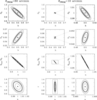
 . Those to the right for a higher resolution experiment
with
. Those to the right for a higher resolution experiment
with  plotted on the same scale (central column) and with expanded scales (rightmost
column). This figure is taken from Bersanelli et al. 1996 [10].
plotted on the same scale (central column) and with expanded scales (rightmost
column). This figure is taken from Bersanelli et al. 1996 [10]. These figures do not, however, take into account any reduction in sensitivity as a result of the need
to separate Galactic foregrounds from the CMB. Nevertheless, simulations using a maximum
entropy separation algorithm (Hobson, Jones, Lasenby & Bouchet, in press) suggest that for the
Planck Surveyor the reduction in the final sensitivity to the CMB is very small indeed, and
that the accuracy of the cosmological parameters estimates indicated in Figure 19 may be
attainable.
One additional problem is that of degeneracy. It is possible to formulate two models with similar power spectra, but different underlying physics. For example, standard CDM and a model with a non zero cosmological component and a gravity wave component can have almost identical power spectra (to within the accuracy of the MAP satellite). To break the degeneracy more accuracy is required (like the Planck Surveyor) or information about the polarisation of the CMB photons can be used. This extra information on polarisation is very good at discriminating between theories but requires very sensitive polarimeters.
 |
 |
 |
| http://www.livingreviews.org/lrr-1998-11 |
© Max Planck Society and the author(s)
Problems/comments to |

