 ]], [44]
and [55]).
]], [44]
and [55]).
If we start with Bayes’ theorem which states, given a hypothesis  and some data
  the posterior
probability
the posterior
probability  is the product of the likelihood
  and the prior probability
  ,
normalised by the evidence
,
normalised by the evidence  ,
,
 misfit statistic has been introduced.
We now have to decide the form of the prior probability. Let us consider a discretised image  consisting of
  cells, so that
  ; we may consider the
  as the components of an image
vector
as the components of an image
vector  . If we base the derivation of the prior on purely information theoretic considerations (subset
independence, coordinate invariance and system independence) we are naturally led to the
Maximum Entropy Method (MEM). It may be shown [85] the prior probability takes the form
. If we base the derivation of the prior on purely information theoretic considerations (subset
independence, coordinate invariance and system independence) we are naturally led to the
Maximum Entropy Method (MEM). It may be shown [85] the prior probability takes the form
 depends on the scaling of the problem and may be considered as a
regularising parameter, and
depends on the scaling of the problem and may be considered as a
regularising parameter, and  is a model vector to which
  defaults in the absence of any
data.
defaults in the absence of any
data.
In standard applications of the maximum entropy method, the image  is taken to be a positive
additive distribution (PAD). Nevertheless, the MEM approach can be extended to images that take both
positive and negative values by considering them to be the difference of two PADS, so that
is taken to be a positive
additive distribution (PAD). Nevertheless, the MEM approach can be extended to images that take both
positive and negative values by considering them to be the difference of two PADS, so that
 and
and  are the positive and negative parts of
  respectively. In this case, the cross entropy
is given by
where
respectively. In this case, the cross entropy
is given by
where ![ψj = [h2j + 4mujmvj ]1∕2](article190x.gif) and
and  and
and  are separate models for each PAD. The global
maximum of the cross entropy occurs at
are separate models for each PAD. The global
maximum of the cross entropy occurs at  . The most probable image
  is then just the
result from finding the maximum probability or, equivalently, the minimum of
is then just the
result from finding the maximum probability or, equivalently, the minimum of  . This can be done
by using any known minimising routine.
. This can be done
by using any known minimising routine.
It can be shown [38] that the Lagrange multiplier  is completely defined in a Bayesian way and any
prior correlation information can also be incorporated into the analysis. Also, the assignment of errors
is straightforward in the Fourier domain where all the pixels in the discretised image will be
independent.
is completely defined in a Bayesian way and any
prior correlation information can also be incorporated into the analysis. Also, the assignment of errors
is straightforward in the Fourier domain where all the pixels in the discretised image will be
independent.
Hobson et al. [38] simulated data taken by the Planck Surveyor satellite and used MEM to
reconstruct the underlying CMB and foregrounds. They used six input maps (the CMB, thermal
and kinetic SZ, dust emission, free-free emission and synchrotron emission) to make up the
data and then added Gaussian noise to each frequency. After using MEM with the Bayesian
value for  and giving the algorithm the average power spectra of each channel, it was found
that features in all six maps were recovered. Without any prior power spectrum information it
was found that only the kinetic SZ was not recovered and all others were recovered to some
degree (the CMB and dust were almost indistinguishable from the input maps with residual
errors of
and giving the algorithm the average power spectra of each channel, it was found
that features in all six maps were recovered. Without any prior power spectrum information it
was found that only the kinetic SZ was not recovered and all others were recovered to some
degree (the CMB and dust were almost indistinguishable from the input maps with residual
errors of  and
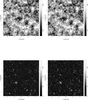
and  per pixel respectively). Figure 20
 shows the results from MEM as
compared to the input maps for the case with assumed average power spectrum. It is easily seen
that MEM reconstructs both the Gaussian CMB and the non-Gaussian thermal SZ effect very
well.
shows the results from MEM as
compared to the input maps for the case with assumed average power spectrum. It is easily seen
that MEM reconstructs both the Gaussian CMB and the non-Gaussian thermal SZ effect very
well.
 |
 |
 |
| http://www.livingreviews.org/lrr-1998-11 |
© Max Planck Society and the author(s)
Problems/comments to |

![Pr(D |H ) ∝ exp[− χ2 (H )] (15 )](article173x.gif)
![Pr(H ) ∝ exp[αS (H, M )], (16 )](article180x.gif)

![L { [ ] } S(H, M ,M ) = ∑ ψ − m − m − h ln ψj-+-hj- , (18 ) u v j=1 j uj vj j 2muj](article189x.gif)