 .) This entails, for example in the case of strings, the calculation of the
properties of the string network through recombination to late times, which is computationally
intensive.
.) This entails, for example in the case of strings, the calculation of the
properties of the string network through recombination to late times, which is computationally
intensive.
The formation of topological defects is a generic property of symmetry breaking in unified field theories, and formation of such defects is expected to occur during phase transitions in the early Universe. Such phase transitions lead to spatial gradients in the value of the field which cannot be eliminated, and the resulting field defects contain energy concentrations that can gravitationally perturb the surrounding matter and thus induce structure formation. Depending on the properties of the field involved, the topological defects are strings, monopoles, walls and textures.
If the seeds for galaxy formation are indeed provided by topological defects, we can expect the
resulting power spectrum of CMB fluctuations to differ from that predicted by inflation. The full
calculation of the power spectrum predicted by defects is much harder than that for inflation, and
consequently the progress in this field has been relatively slow. Qualitatively, however, the main
difference from the inflationary scenario is that all perturbations have to be generated causally,
that is, they must be within the horizon volume at a given epoch. Thus anisotropies on scales
above about 2°, as already measured by e.g the COBE satellite, have to be generated after
recombination, and correspond to late-time effects. (The horizon size grows after inflation,
roughly like .) This entails, for example in the case of strings, the calculation of the
properties of the string network through recombination to late times, which is computationally
intensive.
Recently new techniques to compute the power spectra have become available. Figure 3 shows a
comparison of predictions for global strings, monopoles and textures made by Pen, Seljak & Turok [67
shows a
comparison of predictions for global strings, monopoles and textures made by Pen, Seljak & Turok [67 ] with
experimental results from present CMB experiments.
] with
experimental results from present CMB experiments.
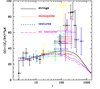
 . This figure was taken from Pen, Seljak & Turok [67].
 The defect model predictions were each normalised to COBE at  . In practice, one is allowed to
slide each of the curves up and down so as to best match a range of criteria, rather than (as here) matching
a single large–scale
. In practice, one is allowed to
slide each of the curves up and down so as to best match a range of criteria, rather than (as here) matching
a single large–scale  value. However, even with this freedom it is easily seen that the models do not fit
the data very well. There appears to be evidence for a much larger acoustic peak in the data than predicted
by defect theories.
value. However, even with this freedom it is easily seen that the models do not fit
the data very well. There appears to be evidence for a much larger acoustic peak in the data than predicted
by defect theories.
The same models can be used to predict the matter power spectrum; this is shown in Figure 4.
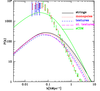
Again, the models have been normalised to COBE, but a change in the normalisation does not appear to be sufficient to produce a good agreement between the predictions and experimental results. Therefore, at present, the models considered by Pen, Seljak & Turok appear to be ruled out by current experimental data, and the case for a topological defect origin of CMB fluctuations is less strong.
However, recent work[7] which uses an analytic expression for the evolution of local strings from the
radiation to matter dominated era as well as including a non-zero cosmological constant, shows that it is
possible to produce results that contain a broad peak in the angular power spectrum of the CMB
(Figure 5). However, this peak occurs at  which is in disagreement with the CAT and
OVRO detections (Table 2) at these scales. The numerical method for calculating the matter and CMB
power spectra used in this work differs from that of Pen, Seljak and Turok. It is unclear at present how to
compare the two sets of predictions.
which is in disagreement with the CAT and
OVRO detections (Table 2) at these scales. The numerical method for calculating the matter and CMB
power spectra used in this work differs from that of Pen, Seljak and Turok. It is unclear at present how to
compare the two sets of predictions.
 |
 |
 |
| http://www.livingreviews.org/lrr-1998-11 |
© Max Planck Society and the author(s)
Problems/comments to |
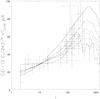
 of 0.0 (short-long dashed), 0.3 (dotted-dashed), 0.5 (short dashed),
0.7 (long dashed), 0.9 (solid line) and standard CDM (dot-dashed).
of 0.0 (short-long dashed), 0.3 (dotted-dashed), 0.5 (short dashed),
0.7 (long dashed), 0.9 (solid line) and standard CDM (dot-dashed).