 ]]. This is a mathematical measure of the topology of the
isodensity surface. For definiteness, consider the density contrast field
]]. This is a mathematical measure of the topology of the
isodensity surface. For definiteness, consider the density contrast field  at the position
  in the survey volume
  . This may be evaluated, for instance, by taking the ratio of the
number of galaxies
. This may be evaluated, for instance, by taking the ratio of the
number of galaxies  in the volume
  centered at
  to its average value
  :
where
:
where  is its r.m.s. value. Consider the isodensity surface parameterized by a value of
 . Genus is one of the topological numbers characterizing the surface defined as
where
. Genus is one of the topological numbers characterizing the surface defined as
where  is the Gaussian curvature of the isolated surface. The Gauss–Bonnet theorem implies
that the value of
is the Gaussian curvature of the isolated surface. The Gauss–Bonnet theorem implies
that the value of  is indeed an integer and equal to the number of holes minus 1. This is
qualitatively understood as follows: Expand an arbitrary two-dimensional surface around a point as
Then the Gaussian curvature of the surface is defined by
is indeed an integer and equal to the number of holes minus 1. This is
qualitatively understood as follows: Expand an arbitrary two-dimensional surface around a point as
Then the Gaussian curvature of the surface is defined by  . A surface topologically equivalent to a
sphere (a torus) has
. A surface topologically equivalent to a
sphere (a torus) has  (
( ), and thus Equation (99
 ) yields
  (
( ) which coincides
with the number of holes minus 1.
) which coincides
with the number of holes minus 1.
In reality, there are many disconnected isodensity surfaces for a given  , and thus it is more
convenient to define the genus density in the survey volume
, and thus it is more
convenient to define the genus density in the survey volume  using the additivity of the genus:
 (
( ) denote the disconnected isodensity surfaces with the same value of
 . Interestingly the Gaussian density field has an analytic expression for
Equation (101):
where
is the moment of
. Interestingly the Gaussian density field has an analytic expression for
Equation (101):
where
is the moment of  weighted over the power spectrum of fluctuations
  and the smoothing function
 (see, e.g., [4]). It should be noted that in the Gaussian density field the information
of the power spectrum shows up only in the proportional constant of Equation (102), and
its functional form is deterimined uniquely by the threshold value
(see, e.g., [4]). It should be noted that in the Gaussian density field the information
of the power spectrum shows up only in the proportional constant of Equation (102), and
its functional form is deterimined uniquely by the threshold value  . This
  -dependence
reflects the phase information which is ignored in the two-point correlation function and power
spectrum. In this sense, genus statistics is a complementary measure of the clustering pattern of
Universe.
-dependence
reflects the phase information which is ignored in the two-point correlation function and power
spectrum. In this sense, genus statistics is a complementary measure of the clustering pattern of
Universe.
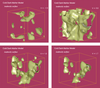
 -body simulation: LCDM in
 at
at  (upper left panel),
  (upper right panel),
  (lower
left panel), and
(lower
left panel), and  (lower right panel). (Figure taken from [54].)
Even if the primordial density field obeys the Gaussian statistics, the subsequent nonlinear gravitational evolution generates the significant non-Gaussianity. To distinguish the initial non-Gaussianity from that acquired by the nonlinear gravity is of fundamental importance in inferring the initial condition of the Universe in a standard gravitational instability picture of structure formation. In a weakly nonlinear regime, Matsubara derived an analytic expression for the non-Gaussianity emerging from the primordial Gaussian field [49]:
where are the Hermite polynomials: ,
,  ,
,  ,
,  ,
,
 , …. The three quantities
denote the third-order moments of
, …. The three quantities
denote the third-order moments of  . This expression plays a key role in understanding if the
non-Gaussianity in galaxy distribution is ascribed to the primordial departure from the Gaussian
statistics.
. This expression plays a key role in understanding if the
non-Gaussianity in galaxy distribution is ascribed to the primordial departure from the Gaussian
statistics.
 |
 |
 |
| http://www.livingreviews.org/lrr-2004-8 |
© Max Planck Society and the author(s)
Problems/comments to |






![( )3 ∕2 [ ( ) ] --1- ⟨k2⟩ −ν2∕2 S- 3T- G(ν ) = − 4 π2 3 e H2 (ν) + σ 6H5 (ν) + 2 H3 (ν) + 3U H1 (ν) , (104 )](article346x.gif)

