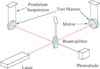
).
).
This technique is based on the Michelson interferometer and is particularly suited to the detection of gravitational waves as they have a quadrupole nature. Waves propagating perpendicular to the plane of the interferometer will result in one arm of the interferometer being increased in length while the other arm is decreased and vice versa. The induced change in the length of the interferometer arms results in a small change in the intensity of the light observed at the interferometer output.
As will be explained in detail in the next section, the sensitivity of an interferometric gravitational
wave detector is limited by noise from various sources. Taking this frequency dependent noise
floor into account, the American LIGO 1 detector will have a sensitivity (shown in Figure 3),
which would allow a reasonable probability for detecting gravitational wave sources. In order to
observe a full range of sources and to initiate gravitational wave astronomy, a sensitivity or noise
performance approximately ten times better in the mid-frequency range and several orders of
magnitude better at 10 Hz, is desired. Such a performance is planned for a future LIGO upgrade,
LIGO 2.
For the initial interferometric detectors we require a noise floor in strain close to 2 × 10–23 (Hz)–1/2 to
be achieved. For an earth based detector the distance between the test masses is limited to a few km by
geographical and cost factors. If we assume an arm length of 3 to 4 km, detecting a strain in
space of the above level implies measuring a residual motion of each of the test masses of about
3 × 10–20 m(Hz)–1/2 over part of the operating range of the detector, which may be from  10 Hz to a
few kHz. This sets an formidable goal for the optical detection system at the output of the
interferometer.
10 Hz to a
few kHz. This sets an formidable goal for the optical detection system at the output of the
interferometer.
 |
 |
 |
|
Living Rev. Relativity 3, (2000), 3
http://www.livingreviews.org/lrr-2000-3 |

This work is licensed under a Creative Commons License. E-mail us: |